IMO Resolution A.382(X): What It Actually Requires
Search the resolution number and you will find the document, a scan of a 1977 typescript, and almost nothing that explains it. That is odd, because it is the standard against which every magnetic compass on every SOLAS ship is judged, and because superintendents get asked about it during inspections.
It was adopted on 14 November 1977, by the Assembly of what was then still called IMCO. It is older than most of the ships it governs. It has never been replaced.
Here is what is in it, and why it matters more than its status suggests.
Two annexes, doing two different jobs
Almost every confused conversation about A.382(X) comes from not knowing which annex is being discussed.
Annex I is about carriage. What has to be on board.
Annex II is about performance. How good it has to be.
If someone asks whether a vessel complies, the honest answer is a question: with which annex? A ship can carry every required instrument and still fail on performance, and a compass can be a superb instrument and still be wrongly sited.
Annex I: what must be on board
Three things, in plain terms.
A standard compass, mounted in a binnacle with the correcting devices and an azimuth reading device.
A steering compass, unless the standard compass heading is made clearly readable to the helmsman at the main steering position. There is a specific allowance here that is worth knowing: if a transmitted image of the standard compass card, showing at least fifteen degrees each side of the lubber mark, is readable at the steering position in both daylight and artificial light, the standard compass counts as the steering compass too.
A spare compass, interchangeable with the standard, unless a steering compass or a gyro is fitted.
Then the sentence that does the real work on board:
Each magnetic compass is properly compensated and its table or curve of residual deviations is available on board in the vicinity of the compass at all times.
Read that carefully. Not filed. Not available on request. In the vicinity of the compass, at all times. This one line is why the deviation card exists as a physical document on a bulkhead rather than a certificate in the office, and it is the line most often failed in practice. If you want the detail on the document itself, we set out what must appear on a deviation card separately.
Annex II: the numbers nobody quotes
This is the part that gets skipped, and it is the interesting part, because it contains actual tolerances.
Card accuracy. The directional error of the card, combining graduation inaccuracy, eccentricity on the pivot and misalignment of the card on the magnetic system, must not exceed 0.5 degrees on any heading.
Readability. The steering compass card must be clearly readable at 1.4 metres in daylight and artificial light. A magnifying glass is permitted. Primary and emergency illumination must both be installed, with dimming.
Positioning. Installed on the ship's centreline where practicable, with the main lubber mark indicating the ship's heading to within ±0.5 degrees.
Settling behaviour. With a horizontal field component of 18 microtesla, the half period of the card must be at least twelve seconds after a forty degree deflection, and the card must return to within one degree of the magnetic meridian inside sixty seconds after a ninety degree deflection.
Correctors. The magnets used in the directional system and for correcting the ship's permanent field must have a coercivity of at least 11.2 kA/m. Material for correcting induced fields must have low remanence and low coercivity, which is why soft iron is soft iron and not something more convenient.
Gimballing. The standard compass must stay level with the binnacle tilted up to forty degrees in any direction. If a steering compass is not gimballed, the card needs at least thirty degrees of freedom in all directions.
Independence. Apart from the lighting, no electrical supply may be required to operate the compass. That single clause is the whole argument for why a magnetic compass is still carried on a bridge full of electronics.
The tolerances that move with you
Several limits in Annex II are not fixed numbers. They are expressed as a formula divided by H, the horizontal component of the Earth's magnetic flux density in microtesla at the compass position.
The deflection under rotation must not exceed 36/H degrees for a card under 200 mm, or 54/H degrees for a card of 200 mm or more. Friction error must not exceed 3/H degrees. Deviation caused by supposedly non-magnetic materials in the compass and binnacle must not exceed 9/H degrees.
This is more elegant than it first looks. The Earth's horizontal field is strong near the equator and weak at high latitude, and a weaker field means the same physical imperfection produces a larger angular error. So the standard tightens the physical tolerance exactly where the physics is least forgiving. A compass that behaves well in the tropics is not automatically compliant in the Baltic in winter.
What Annex II asks the correctors to cancel
The binnacle has to carry devices for correcting deviation arising from four sources:
The horizontal components of the ship's permanent magnetism
Heeling error
The horizontal component of induced horizontal magnetism
The horizontal component of induced vertical magnetism
And then a requirement that is easy to read past: after correction, sextantal and higher order deviations should be negligible, and no serious change of deviation should occur under significant change of magnetic latitude.
That second half is a real operational constraint. It says the correction must hold as the vessel moves between magnetic latitudes, which is precisely what a Flinders bar exists to manage and precisely why a compass that was fine on delivery can be out after a long voyage into a different field. It is one of several reasons how often a compass has to be swung is not a simple calendar question.
A recommendation that became a rule
Here is the part that catches people out.
Read the resolution and it never commands anything. It recommends that Member Governments put the provisions into effect. It recommends that compasses installed after adoption conform to standards not inferior to Annex II. On its own, it has no force at all.
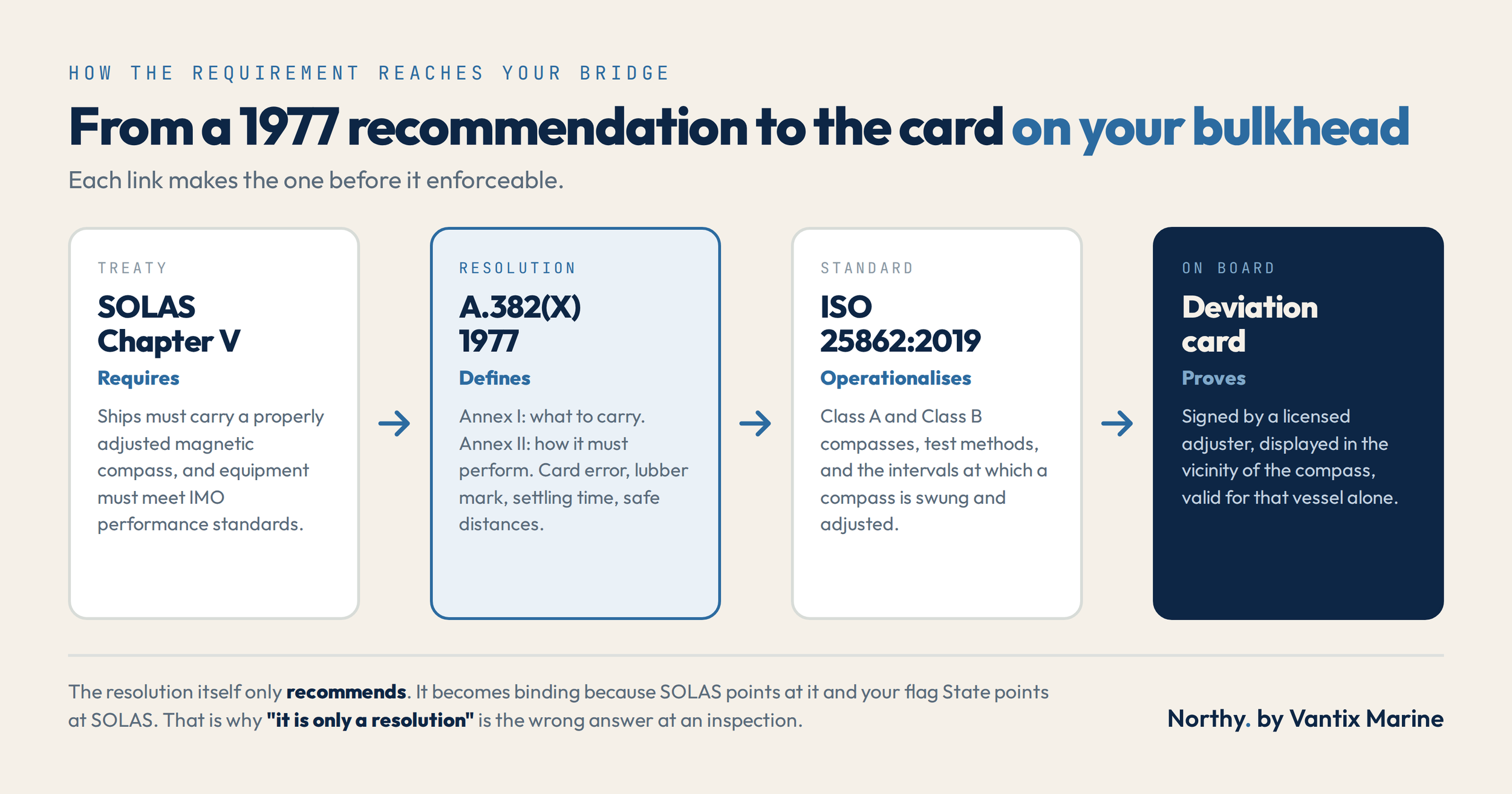
It became binding by being pointed at. SOLAS Chapter V requires ships to carry a properly adjusted magnetic compass and requires equipment to meet IMO performance standards. For magnetic compasses, the performance standard it means is A.382(X). Your flag State then enforces SOLAS, and a port State control officer checks against the flag State's requirements.
So the chain runs: treaty requires, resolution defines, standard operationalises, and the card on your bulkhead proves.
Which is why "it is only a recommendation" is a bad answer during an inspection. Nobody is enforcing the resolution. They are enforcing SOLAS, and SOLAS has adopted the resolution's numbers as its own.
Where ISO 25862 fits
A.382(X) sets what the instrument must do. ISO 25862:2019, the current edition of the standard covering marine magnetic compasses, binnacles and azimuth reading devices, is what turns that into testable practice. It defines Class A and Class B compasses, sets out test methods, and addresses the intervals at which a compass is swung and adjusted.
Flag State guidance typically cites both together. The Marshall Islands marine notice on compass adjustment, for instance, lists A.382(X) and ISO 25862:2019 side by side as its references, and requires that observed accuracies stay within two degrees of the residual deviation table.
Neither document replaces the other. The resolution is the performance floor. The ISO standard is how the floor gets checked.
What this means in practice
Three things a superintendent can use.
The card is a physical requirement, not an administrative one. In the vicinity of the compass, at all times. An expired card in a drawer fails the requirement even if a valid one exists somewhere in the fleet office.
Compliance is not permanent. The correction has to hold across magnetic latitudes, and the resolution says so. Dry dock, structural work, new bridge equipment near the binnacle, or a long passage into a very different field all put the existing card in question.
The numbers are checkable. Lubber mark within half a degree, card readable at 1.4 metres, emergency lighting present, settling inside sixty seconds. Most of Annex II can be verified on a bridge in ten minutes by someone who knows what to look for.
And if a compass is out, the correction still happens on board, by hand, with magnets and soft iron. What no longer has to happen on board is the specialist. The swing data, the coefficient calculation, and the adjuster's review and signature can now be adjusted and certified remotely, which matters more each year as the number of practising adjusters falls.
One last thing worth keeping straight while reading any of this: the deviation A.382(X) is concerned with is a property of your ship, not of the Earth. If that distinction is not solid, deviation is not variation is the shorter read.