How often must a magnetic compass be adjusted?
The short answer: at least once every two years, and sooner whenever something changes the ship's magnetism. The calendar sets a floor, not the full rule. Here is how often a magnetic compass must be adjusted, every trigger that brings it forward, and what happens if the card runs out.
See how remote magnetic compass adjustment works.
The two-year rule
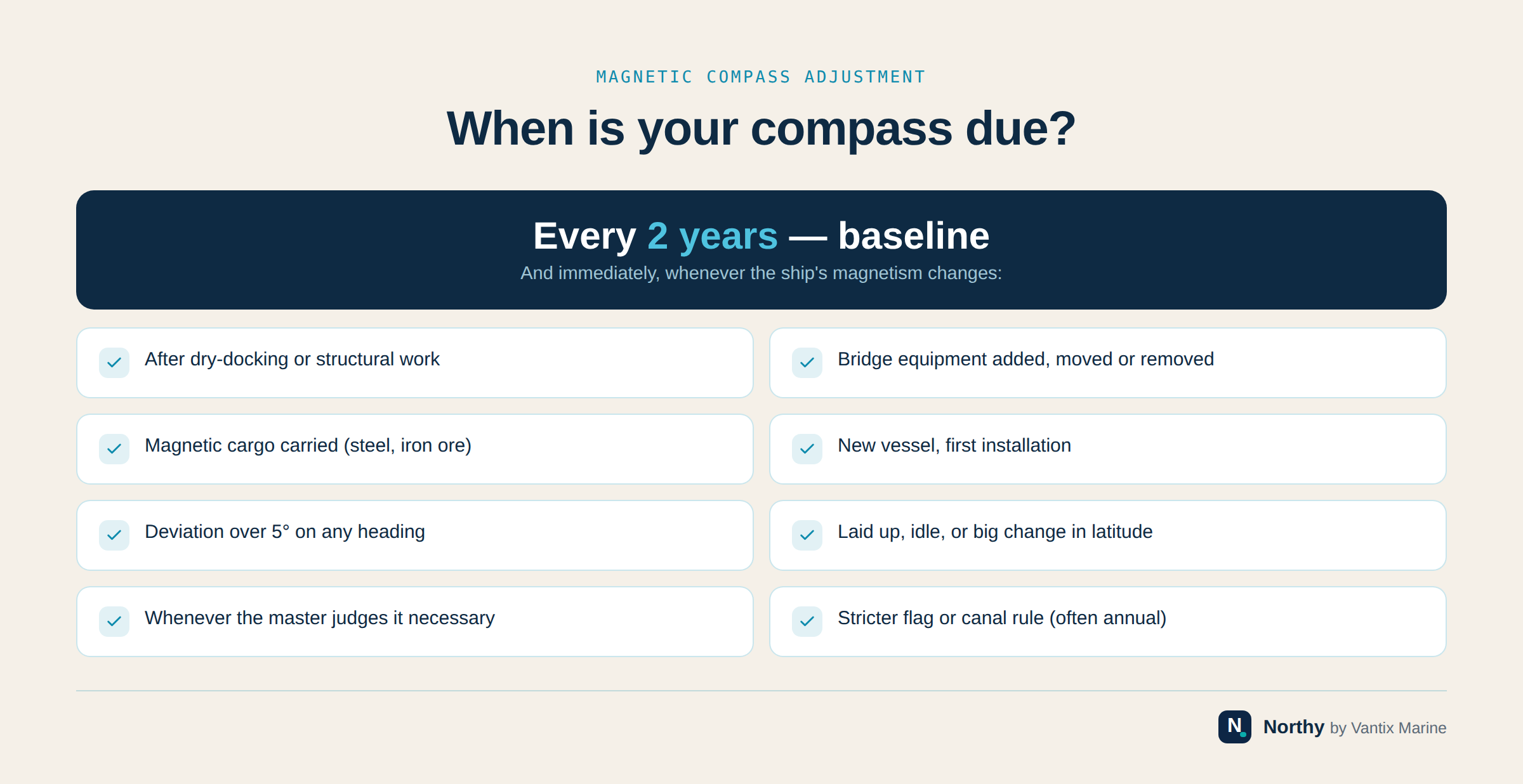
ISO 25862:2019, the standard for marine magnetic compasses, requires a SOLAS vessel's compass to be swung, adjusted, and issued a fresh deviation card no less than every two years. That is the baseline every ship works from. A compass that has had a quiet two years is still due the day the interval runs out, even if it reads perfectly.
The calendar is not the only trigger
A compass also falls due, regardless of when it was last done, when any of these happen:
The vessel is dry docked, or has significant structural or steel work. Welding and hull work change a ship's magnetic signature.
Electrical or magnetic equipment near the compass is installed, moved, or removed. New bridge electronics can shift deviation overnight.
Magnetically significant cargo has been carried, such as steel coils or iron ore.
The compass is first installed on a new vessel.
The compass becomes unreliable, or recorded deviation on any heading passes five degrees.
The vessel has been laid up or idle, or has made a large change in magnetic latitude.
The master judges it necessary for safe navigation.
Any one of these resets the clock. A ship leaving dry dock is due immediately, no matter how recently it was last swung.
Stricter rules you should know
Two years is the general floor. Some regimes want it more often:
The Panama Canal requires vessels of 150 gross tons and over to hold a deviation card issued within the previous twelve months.
A number of flag administrations and operators apply an annual cycle as standard.
Certain trades and national waters carry their own requirements.
Always check the strictest rule that applies to the vessel's flag, trade, and route. When two rules overlap, the shorter interval wins.
Adjusting is not the same as checking
Adjustment is the formal job: a certified adjuster swings the compass, corrects it, and issues a new deviation card. That is the two-year event.
Checking is the daily duty: the crew records the compass deviation in the deviation book at regular intervals, ideally each watch and after any large course change, so a growing error is caught early. Checking often does not replace adjusting on schedule. It tells you whether you need to adjust sooner.
What happens if it is overdue
Port State Control looks for a current deviation card during inspection. A missing or expired card is a deficiency, and it can hold up the ship. If the residual deviation on any heading is over five degrees, the compass needs adjustment before it is compliant again. An overdue compass is not just paperwork. It is the one heading reference that still works when the power is gone, so an inaccurate one is a real safety gap.
Who is allowed to do it
The adjustment must be carried out by a duly authorized, certified compass adjuster. A master may do it only where no certified adjuster is available, and only if they are themselves certified for it. We cover who sets these rules in more detail in Who regulates magnetic compass requirements?
The easy way to stay current
At Vantix Marine we are certified compass adjusters, and through our platform Northy we do it remotely. When your compass comes due, your officer takes the readings on the bridge with guided steps, a certified adjuster reviews and signs off, and your deviation certificate is issued the same day. No port call, no waiting for a slot.
Learn more about our remote magnetic compass adjustment.