Who regulates magnetic compass requirements?
No single body does. A ship's magnetic compass sits under three separate instruments, and they only count when they work together. Satisfy two and miss the third, and you are not compliant. Here is who sets the rules for magnetic compass adjustment, what each one demands, and why a certified adjuster is the person who ties them together.
Find out more about remote magnetic compass adjustment.
Three instruments, one compass
SOLAS Chapter V, Regulation 19 is the law. It says you must carry a properly adjusted standard magnetic compass.
IMO Resolution A.382(X) is the performance standard. It says how well the compass must perform and what must be kept beside it.
ISO 25862:2019 is the technical standard. It sets the intervals, the method, and the limits the adjustment must meet.
One says you must have it. One says how good it has to be. One says how, and how often, to prove it. Compliance is all three at once.
SOLAS Chapter V, Regulation 19: the requirement
Every ship must carry a properly adjusted standard magnetic compass, independent of any power supply, to determine and display her heading. The magnetic compass is mandatory precisely because it needs no power. When the gyro fails or the ship loses electrics, it is the only heading reference left. SOLAS also requires a table of the compass's deviations to be available on board at all times.
IMO Resolution A.382(X): the performance standard
A.382(X) defines what "properly adjusted" means in practice. Each compass must be properly compensated, and the table of residual deviations must be available in the vicinity of the compass at all times, not filed away in the office. Deviations should be recorded in the compass deviation book at regular intervals, ideally each watch and after any large alteration of course.
ISO 25862:2019: the technical standard
This is the current standard for marine magnetic compasses and their adjustment, and it sets the numbers. A SOLAS vessel's compass should be swung, adjusted, and issued a fresh deviation card no less than every two years, and again after dry docking or significant structural work. It also fixes how accurate the result has to be: on a newly commissioned vessel, deviation on any heading should be no more than 3 degrees; after that, 5 degrees or less on any heading.
When must a magnetic compass be adjusted?
Not only on a calendar. A compass falls due when any of these happen:
Two years have passed since the last adjustment.
It is first installed on a new vessel.
The vessel has been dry docked or had significant structural or steel work. Welding and hull work change a ship's magnetic signature.
Electrical or magnetic equipment near the compass is added, moved, or removed. New bridge electronics can shift deviation overnight.
Magnetically significant cargo has been carried, such as steel or iron ore.
The compass has become unreliable, or recorded deviation on any heading exceeds five degrees.
The vessel has been laid up or idle, or has made a large change in magnetic latitude.
The master judges it necessary for safe navigation.
A quiet two years still puts a compass due on the interval. A ship just out of dry dock is due immediately, no matter how recently it was last done.
Residual deviation and the deviation card
No compass reads perfectly on every heading. What remains after adjustment is the residual deviation, and it is recorded on the deviation card, the small table that must stay by the compass. Port State Control checks for a current card during inspection. A missing or expired card is a deficiency, and the residual deviation on it has to sit inside the limits above. The card is the proof that the job was done, and done properly.
Why all three have to be in harmony
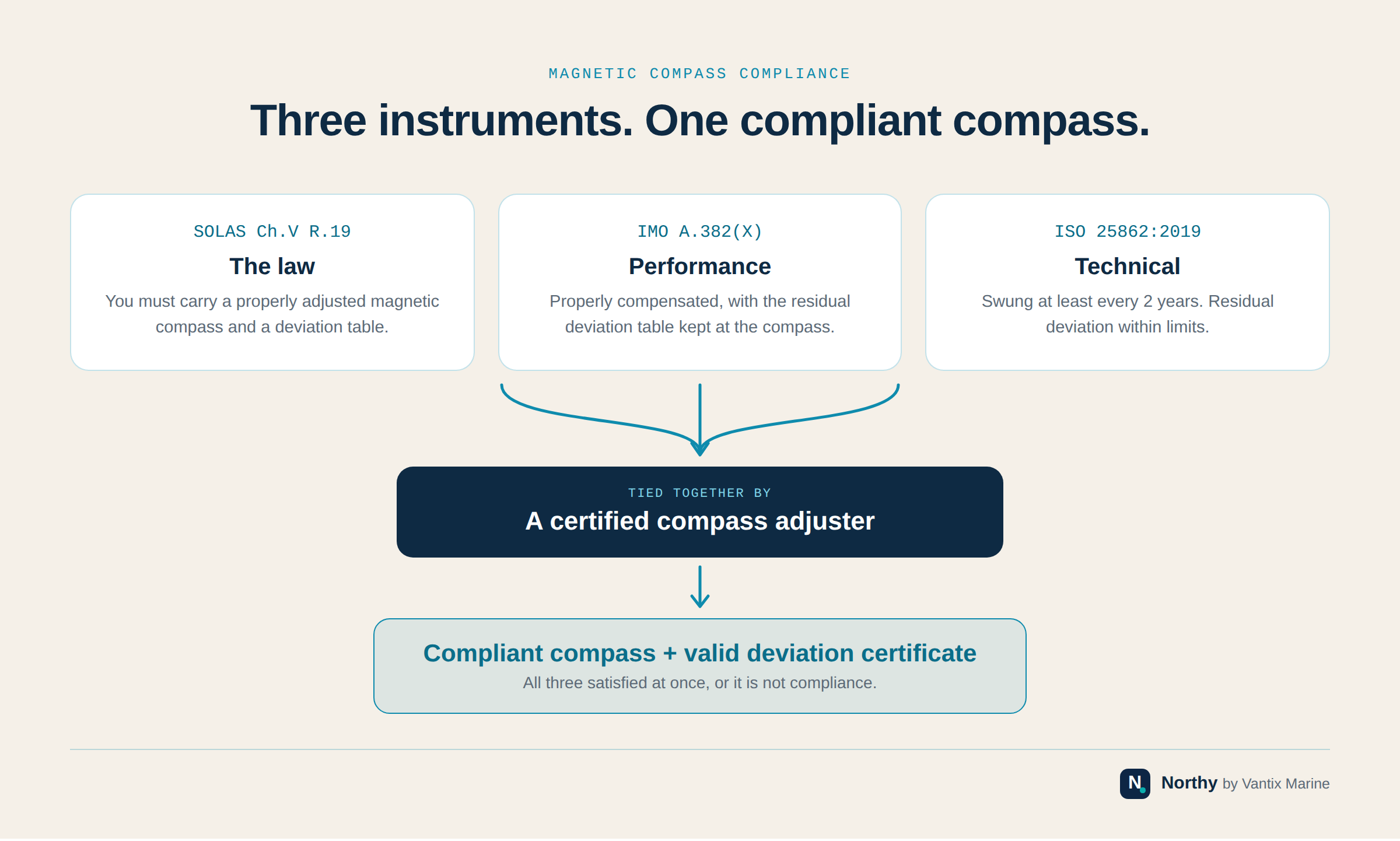
This is the part that catches vessels out. You can have the compass on board, as SOLAS demands, but if the residual deviation is outside ISO limits, you are not compliant. You can meet the ISO limits, but if the card is not physically at the compass as A.382(X) requires, you are not compliant. Each instrument covers what the others do not. Meeting one is not the same as meeting the requirement. A proper adjustment answers all three at the same time.
Who is allowed to adjust it?
The adjustment must be made by a duly authorized, certified compass adjuster. Only where a certified adjuster is unavailable, and the master judges it necessary, may the master carry it out, and the master too must be certified for it. This is not a job you hand to just anyone. Reading a deviation curve, separating the ship's permanent and induced magnetism, and correcting it without making it worse at another latitude takes trained judgment. Repairs to the compass itself should be left to the manufacturer or another competent person.
How we do it
At Vantix Marine we are certified compass adjusters, and every adjustment we issue is worked to all three instruments together: SOLAS Chapter V, ISO 25862:2019, and IMO Resolution A.382(X). Through our platform, Northy, we now do it remotely. Your officer takes the readings on the bridge with guided steps, the platform calculates, a certified adjuster reviews and signs off, and your deviation certificate is issued the same day. No port call, no waiting.
Learn more about our remote magnetic compass adjustment.