What is a Compass Deviation card, and what must be on it?
No compass reads perfectly on every heading. Steel moves, equipment changes, and the ship's own magnetism pulls the card away from magnetic north by a different amount depending on which way she is pointing. The deviation card is the document that records exactly how much, on every heading, after the compass has been adjusted. It is also the single piece of paper an inspector asks for first.
Dive into remote magnetic compass adjustment to find out more.
What a deviation card actually is
It is a table, sometimes a curve, showing the residual deviation left on the compass after adjustment, heading by heading. Residual means what is left over. An adjuster does not remove deviation entirely, that is not possible on a steel ship. The job is to reduce it within limits and then record honestly what remains, so the officer on watch can apply it and steer accurately.
Deviation is expressed in degrees East or West. East means the compass reads lower than magnetic, west means it reads higher. The officer applies the correction from the card to convert between compass and magnetic heading.
A card must be prepared every time the compass is adjusted
This is the rule that catches people out. The card is not a permanent fixture of the ship. A new one must be prepared each time the compass is adjusted, and the old one stops being valid the moment the new swing is done. If a vessel has been adjusted since her last card was issued and the old card is still in the frame, the paperwork is wrong even though the work was right.
A separate card must be prepared for the standard compass and, if fitted, for the transmitting magnetic compass repeater, by comparing headings. One card does not cover both. The full list of triggers is in how often a compass must be adjusted.
What must be on it
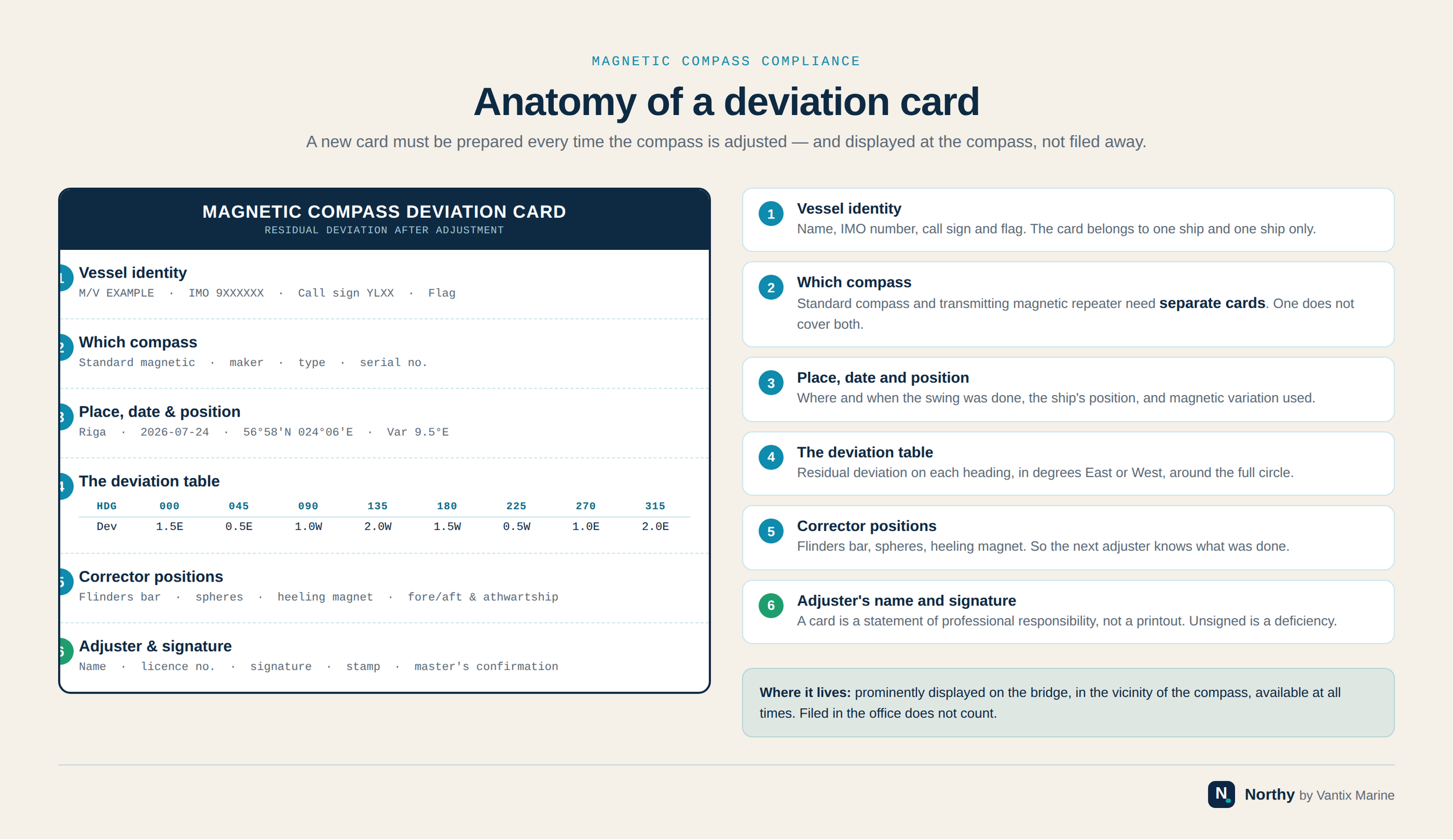
Requirements are set out in ISO 25862:2019 and applied through flag state marine notices, so always check the specific requirements of your flag. In practice a compliant card carries all of the following:
Vessel name, IMO number, call sign and flag
Compass type, maker and serial number, and which compass the card refers to (standard or repeater)
Place where the adjustment was carried out
Date of the adjustment
The deviation table itself, giving residual deviation on each heading, normally at regular intervals around the full circle
The position of the correctors after adjustment, including the Flinders bar, the quadrantal spheres and the heeling magnet
Magnetic variation at the place and time of adjustment, and the ship's position
Name of the compass adjuster, with signature and stamp
Master's confirmation, where the flag requires it
Two things worth stressing. The corrector positions matter because they let the next adjuster understand what was done, and they are part of the record a surveyor may ask to see. And the adjuster's name and signature matter because the card is a statement of professional responsibility, not a printout.
The residual deviation limits
The card only counts if the numbers on it sit within limits. As an example of how flags apply the standard, the Marshall Islands Administrator requires residual deviation within 3 degrees for vessels of 500 GT and above, and within 4 degrees for vessels below 500 GT, with observed accuracies within 2 degrees of the table or curve. Other flags set their own figures. Check yours, and if two rules overlap, the stricter one applies.
Where the card has to be kept
Not in the office, not in a folder in the chart room drawer. The residual deviation table or curve must be prominently displayed on the bridge, in the vicinity of the compass, available at all times. This is the requirement people fail most often. The adjustment was done, the card exists, and it is filed somewhere sensible and useless. On the bridge, by the compass, visible.
The card and the deviation book are not the same thing
They are separate records and both are required.
The deviation card is the result of an adjustment, prepared by the adjuster, displayed by the compass.
The compass deviation book is the ongoing log kept by the ship. Watchkeepers check the compass error after each major course alteration, or at least once per watch where no major alteration has taken place, and record it. An entry is made when the vessel enters and leaves dry dock. The date of any adjustment goes in the book too, together with the position of all correctors and the vessel's position and sea conditions at the time.
The book is how a growing error gets caught between adjustments. The card is how the current error gets applied today. Producing one when an inspector asks for the other does not help you.
What Port State Control looks for
In practice: is there a card, is it current, is it displayed by the compass, is it signed by an adjuster, and do the recorded deviations sit within limits. A missing, expired or unsigned card is a deficiency. So is a card that shows deviations outside the allowed figures, because at that point the compass needs adjusting before the vessel is compliant again.
None of this is bureaucracy for its own sake. The magnetic compass is the heading reference that still works when the power is gone, and a compass whose error nobody has recorded is a compass nobody can trust.
How we issue the card
At Vantix Marine we are certified compass adjusters. Through our platform Northy, the vessel's officer takes the readings on the bridge following guided steps, the platform calculates the residual deviation, and a certified adjuster reviews and signs the result. The deviation certificate and card are issued the same day, complete with corrector positions and signature, ready to be printed and displayed at the compass.
Learn more about our remote magnetic compass adjustment.