Can a magnetic compass be adjusted remotely, and is it accepted?
The regulations set who must carry out the adjustment and what the result must achieve. Neither one requires the adjuster to be standing on the bridge. Find out exact procedures in remote magnetic compass adjustment.
It is the first question every superintendent asks, and it is the right question. A deviation certificate is only worth anything if it holds up in front of a Port State Control officer. So before anyone books a remote adjustment, they want to know whether it will be accepted.
The answer sits in what the rules actually say, and what they do not say.
What the regulations require
Three instruments govern the magnetic compass, and we covered how they fit together in who regulates magnetic compass requirements.
SOLAS Chapter V requires a properly adjusted standard magnetic compass and a deviation table available on board.
IMO Resolution A.382(X) sets the performance standard and requires the residual deviation table to be kept at the compass.
ISO 25862:2019 sets the method, the intervals and the limits the result must meet.
Read them and you will notice what is being regulated: who is qualified to do the work, and what the result has to achieve. The compass must be properly adjusted. The residual deviation must sit within limits. A card must be produced, signed, and displayed. The adjustment must be carried out by a duly authorised, certified compass adjuster.
None of those requirements say where the adjuster must be standing while the ship swings.
Where the ship's own crew already comes in
This is worth pausing on, because it undercuts the instinct that adjustment must be a hands-on visit.
The readings on any swing are taken by the ship. The vessel steers the headings, the officer reads the compass, the crew moves the correctors under instruction. That is true whether the adjuster is on the bridge or not. What the adjuster brings is judgment: reading the deviation, separating the ship's permanent and induced magnetism, deciding what correction to apply, and taking professional responsibility for the result.
Judgment travels. It always has. Compass adjustment has been done by correspondence and by instruction in various forms for a long time, because the skill being applied is analytical, not manual.
One flag says it in plain words
Here is the concrete part, and it is the reason this question is easier to answer than it used to be.
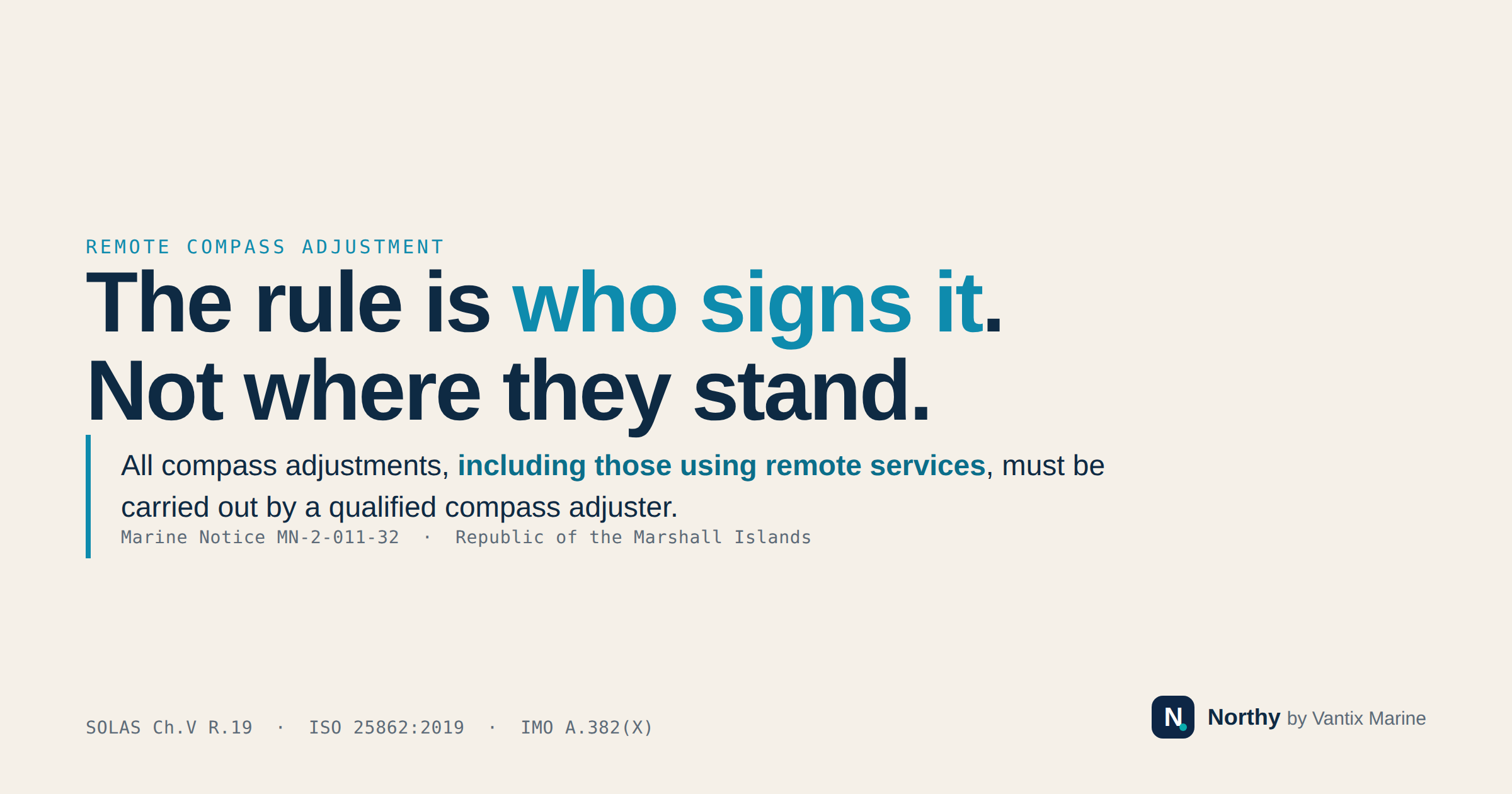
The Republic of the Marshall Islands, one of the world's largest registries, sets out its compass adjustment policy in Marine Notice MN-2-011-32. Section 5.1 states that all compass adjustments, including those using remote services, must be carried out by a qualified compass adjuster.
Read that carefully. The administration does not prohibit remote adjustment. It contemplates it directly, and then applies the same condition it applies to any adjustment: a qualified adjuster must carry it out. The requirement is on the person, not the postcode.
That is the whole legal picture in one sentence, from a flag administration rather than from a service provider.
What still has to be true
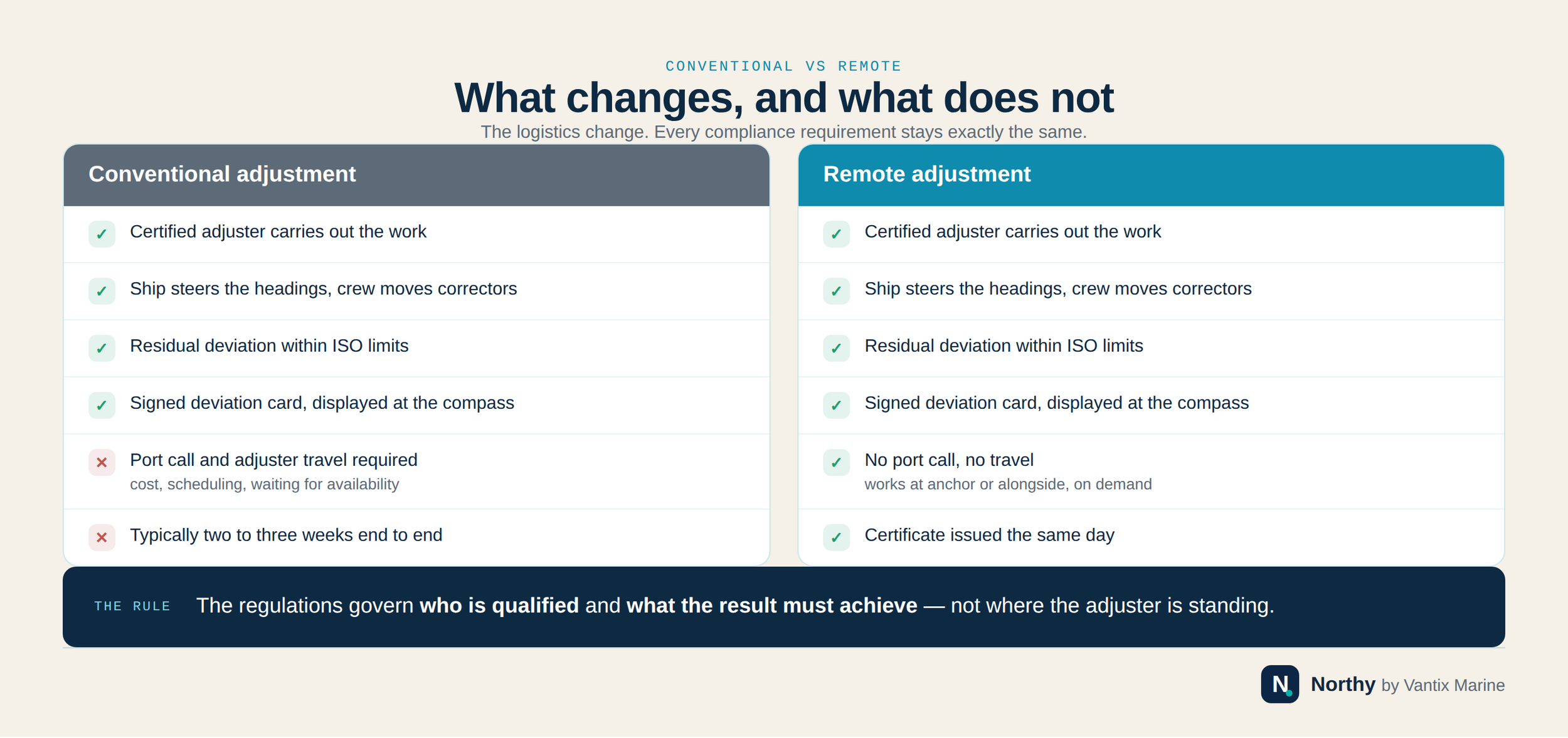
.Remote does not mean relaxed. Every requirement that applies to a conventional adjustment applies unchanged:
A certified compass adjuster must carry out the adjustment and take responsibility for it.
The residual deviation must be within limits. As an example of how flags apply ISO 25862:2019, the Marshall Islands requires residual deviation within 3 degrees for vessels of 500 GT and above and 4 degrees below 500 GT, with observed accuracies within 2 degrees of the table or curve. Check your own flag's figures.
A deviation card must be prepared, signed, and displayed at the compass, with corrector positions recorded. What must be on a deviation card is covered here.
The deviation book entries must be kept by the ship as normal.
The adjustment must happen when it is due. How often a compass must be adjusted has not changed either.
If a remote service skips any of that, the problem is the service, not the fact that it was remote.
What to check with your own flag
Flag administrations administer SOLAS, and they can be stricter than the baseline. Some publish detailed compass policy in a marine notice, some do not. Before booking any adjustment, remote or conventional, it is reasonable and professional to:
Check your flag's marine notice on magnetic compasses for the residual deviation limits and any documentation requirements.
Confirm the adjuster's certification and that it is recognised for your vessel.
Make sure the certificate you receive carries everything the flag expects to see on it.
Any adjuster worth using will help you do that rather than wave the question away. If a provider cannot tell you which standards their certificate is produced to and who signed it, that is your answer.
The honest summary
Can a magnetic compass be adjusted remotely? Yes. The rules govern the qualification of the adjuster and the quality of the result, and one major administration names remote services explicitly while applying exactly the same condition it applies to everyone else.
Is it accepted? It is accepted on the same terms any adjustment is accepted: certified adjuster, deviation within limits, proper card, displayed at the compass, records kept. Meet those and you have a compliant compass. Miss them and you do not, whether the adjuster flew in or not.
How we do it
At Vantix Marine we are certified compass adjusters. Through our platform Northy, the vessel's officer takes the readings on the bridge following guided steps, the platform calculates the residual deviation, and a certified adjuster reviews the result against the limits and signs it off. The deviation certificate is issued the same day, produced to SOLAS Chapter V, ISO 25862:2019 and IMO A.382(X), with the adjuster's name and signature on it.
No port call, no travel, no waiting for someone to be free in your area. And nothing skipped.
Learn more about our remote magnetic compass adjustment.