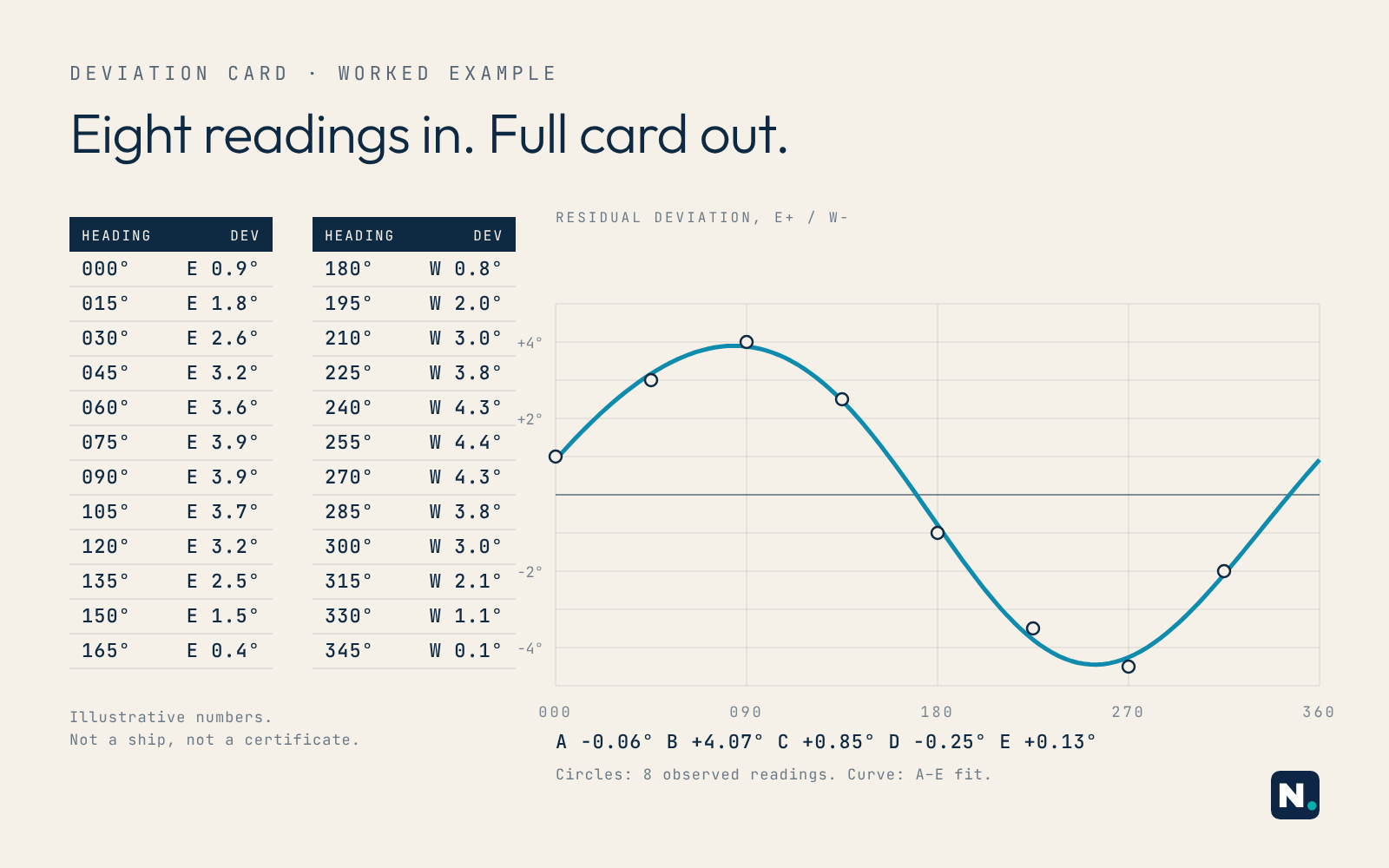
A deviation card is the table that tells the officer of the watch how much the ship's own steel bends the compass on each heading. This page gives you a free compass deviation card template in Excel, a blank card to print, and a calculator that builds a full table from eight readings.
It does not replace an adjustment. A card has to come from an adjustment carried out by a duly authorised, certified compass adjuster. What this page does is make the card, and the maths behind it, easy to read and check.
Download the template
The workbook has two sheets:
Deviation card: enter eight observed deviations, get the coefficients A to E, a table every 15 degrees, a limit check and a curve.
Blank card: a printable card with vessel, compass, adjuster and 24 heading rows to fill in by hand.
Yellow cells are inputs. The limit cell defaults to 3 degrees. Change it to the figure your flag applies.
The calculator
Enter the residual deviation on eight compass headings, east plus and west minus.
Deviation card calculator
ENTER THE RESIDUAL DEVIATION ON 8 COMPASS HEADINGS. EAST +, WEST −. DEGREES.
Method: δ(H) = A + B sin H + C cos H + D sin 2H + E cos 2H, with A–E from eight readings at 45° intervals. It is an approximation, so the curve can miss the observed values by a fraction of a degree. The physical card is made from observed values after adjustment, signed by a certified adjuster. Check your flag's limits and intervals. This tool does not replace an adjustment or a certificate.
"Load example" fills in a worked case. Values above your limit turn red in the table.
What the card must show
Requirements vary by flag, but cards that inspectors accept carry the same basics:
vessel name, IMO number, call sign and flag
which compass the card refers to
place, date and the magnetic variation used
the residual deviation on each heading, as a table and as a curve
the corrector positions after adjustment
the adjuster's name, certificate and signature or stamp
The deviation table must be kept in the vicinity of the compass (IMO Resolution A.382(X)). More on the contents in what must be on a deviation card.
How to read it
Find your compass heading on the card, read the deviation, and apply it with the variation. That is the TVMDC chain: True, Variation, Magnetic, Deviation, Compass.
Easy rule, going from compass to true: add easterly errors, subtract westerly ones. And the mnemonic: error east, compass least; error west, compass best. If the error is east, the compass reads less than the true heading.
Three worked examples (all verified):
Compass 090°, deviation 3°E, variation 4°W. Total error 1°W. True heading 089°.
Compass 270°, deviation 2°W, variation 5°E. Total error 3°E. True heading 273°.
True 045°, variation 2°E, deviation 1°W. Total error 1°E. Steer compass 044°.
Variation comes from the chart. Deviation comes from the card. The difference between them is the subject of deviation versus variation.
Where the coefficients come from
Deviation on any heading H can be approximated by:
δ = A + B sin H + C cos H + D sin 2H + E cos 2H
A is a constant error, for example a misaligned lubber line.
B and C are the semicircular terms, from permanent magnetism and vertical soft iron.
D and E are the quadrantal terms, from horizontal soft iron.
With readings on N, NE, E, SE, S, SW, W and NW, the five coefficients follow from simple averages, which is exactly what the template does. It is an approximation: the curve can miss the observed values by a fraction of a degree, and the physical card is made from observed values after adjustment. In our worked example the fit misses by at most 0.3 degrees at the readings.
How long is a card valid?
SOLAS sets no adjustment interval. The flag does. Panama requires adjustment at a maximum of one year, or when deviation exceeds 5 degrees. Malta sets a maximum of three years. ISO 25862 recommends no less often than every two years.
Whatever the interval, adjust again after dry-docking, structural changes, new equipment close to the compass, or any time deviation looks wrong. The full picture is in how often a magnetic compass must be adjusted. What Port State Control data shows about the compass is in our Port State Control data post.
Common questions
How long is a compass deviation card valid for? It depends on your flag. Panama sets a one-year maximum, Malta three years, and ISO 25862 recommends two. SOLAS sets none.
Can I make my own deviation card with this template? You can fill in the template to read and check your readings. A card that goes on the bridge as the official record has to come from an adjustment by a certified adjuster, signed and displayed at the compass.
What is the difference between a deviation table and a deviation card? Industry usage mixes them. IMO A.382(X) speaks of a table or curve of residual deviations kept near the compass. "Card" is what most ships call it.
What limit should I check against? Your flag sets it. For example, the Marshall Islands applies 3 degrees for vessels of 500 GT and above and 4 degrees below. Check your own flag's notice.
Is the calculator accurate? It uses the standard eight-heading method and shows its own fit error. It cannot see higher-order effects, so a real card should be built from observed values.
Is the card the same as the deviation book? No. The book records changes over time. The card is the current table, kept at the compass.
Need the real card?
A certified adjuster can carry out the adjustment and issue the card without a port call. See remote magnetic compass adjustment, and read whether it is accepted.
Sources: IMO Resolution A.382(X); Panama MMC-138 (April 2024); Transport Malta SLS.13; ISO 25862 as summarised by IR Class Technical Circular 44/2016; Marshall Islands Marine Notice MN-2-011-32; Isle of Man MSN 007.